Murmurings from Godzone

Monday, December 3, 2012

Marcia Russell


Some 20 years ago, I picked up the phone extension in the woolshed office and the person on the other end introduced herself as Marcia Russell.  I knew I knew that name from somewhere; surely this was the editor of “Thursday” magazine.  But why was she ringing me?  “I have a daughter”, she said, “who was recently diagnosed as having Prader-Willi syndrome by the mother of another girl with PWS, standing at the counter of a shop in town.  I just need to talk.”  A good hour later, I felt as though I’d found a kindred spirit.  Although Kate was a few years older than my daughter, Francie, what Marcia and Tom had gone through rang so many bells that it could have been orchestrated.   

This was the beginning of a long friendship, founded on PWS, but built by each of us into a strong relationship.  I have always felt lucky to know Marcia – for a start, she was a strong role model for all of us growing up in the 60s; her vibrancy, great sense of humour, her verbal skill, her ability to quickly grasp a situation, to sort the wheat from the chaff, is a rare find.  It wasn’t long before I asked her if she would be part of the PWS Association that I was struggling to form.  So many parents whose children had PWS were simply unable to commit to anything else but trying to grapple with their own situation.  But Marcia had enough energy and drive to do both and for many years she was a strong member of the Association’s Board.  She knew and understood the limitations of the syndrome, the difficulties faced by parents and families, the issues in confronting disbelieving professionals, and was able to educate and inform and support others.   She, and Tom, attended conferences, met with, and also hosted specialists of the syndrome
When Kate went to  Salisbury School for Girls in Richmond, Nelson, Marcia took a seat on the board and became Chair.  Her ability to lead the board was exemplary and she guided Salisbury through some difficult times.  I know this from firsthand experience as I also joined the board as our daughters progressed their way through the school. 

Marcia’s loyalty as a friend could never be doubted.  Her loyalty to our New Zealand PW Association was always strong and she brought wisdom, wit, and compassion to her job.   In those days when I was often struggling to run the Association, I could always rely on her to hear me out, offer wise counsel and give support.   I know others have found the same. 

We shared some good times over a few glasses of wine. Laughter and tears of mirth and despair.  


Marcia died on 1 December, 2012.   I shall miss her greatly.

Thursday, November 15, 2012

On becoming a grandparent

I have a grandson!  Our first grandchild!  There is great joy in that statement; hard to describe really, as it is quite different from the joy of having one's first child.  There is a sense of great satisfaction in knowing that you have helped carry on the line, as it were, you are continuing the will of the world, to procreate.

Some years ago, I recognised in myself a sense of emptiness.  Not the 'empty nest' syndrome, as that had occurred many years before when all three children had grown up and left home.  No, it was another sense of emptiness and I could not identify it until, at last, I realised it was a real deep need to know that there would be children from my children.  Weird.  Never thought about it before, never really worried or wondered, but here it was, presenting itself in a very physical way - a hollow that needed to be filled.

So, on 1st October, a baby son was born to my firstborn daughter.  The emptiness had gone - filled by new life.  The sweetest baby imaginable.  Everyone says that of their own - so it must be true.  We travelled to Australia to visit the new little family.  To wonder at the new life.  To watch him breathe, hear him cry, marvel at his perfection!

Now, he is smiling.  I can't wait to watch this child grow!


Wednesday, November 14, 2012

Kneed it?

I think I am my own worst enemy.  After having my hip done in July this year, I went back for further punishment in the form of a knee replacement.  On the opposite side to the hip.  My God.  I have never known so much agony and pain as in the first two weeks after the operation.  There was no escaping it - nowhere to hide, to curl up, to ignore the pain.  Sleep was non-existent, and tiredness affected the healing process as well. Tears were never far away.

I gathered around me whispers and threads of advice.  Someone here, with a suggestion of arnica creme to massage into the bruised leg; someone there with the thought of arnica drops to be taken orally for bone healing.  Another clue in the type of drugs I was taking (opiates) that it was ok to change them.  (Oh, they were wicked - deadening the mind, not the pain.)  Another whisper of sleeping pills - ok to take a whole one each night until you can sleep without them. Someone else with the valued knowledge of what a tubular bandage could do to help support the leg and dissipate the pain a little.  Finally, an 'ice sleeve' that wraps around the knee and fills by vacuum method with ice water.  The chill of the ice kind of overwhelmed the pain of the knee and, by concentrating on the coldness, I could overcome the pain and even sleep. Once the stitches came out and the leg stopped looking like a rolled and tied lump of meat, stretching and extending became a little easier.

Then, on day 16, a kind of breakthrough - the bruising diminished and along with that, almost overnight, went at least 60% of the pain.  I didn't dare say anything for two days, just in case I was wrong and pain was simply waiting around the corner.  But I think it is true - the bruising and having to work through the damaged muscles was causing more pain than anything else.  Did the arnica work its miracle?  yes, I think so!  To be through that pain barrier and on the other side is incredibly rewarding.  So is sunshine, and so is laughter.  I have my sister staying with me and together we can work up quite a level of childish hysteria at past things forgotten, but still hilarious.  Laughter at that level where you can barely draw breath, is so cleansing and makes you feel really happy.

There are more joints to go.  I know.  I've inherited bad joints - I have only to think of my little old grandmother, who died at the ripe old age of 93, and her bandy little legs which looked as though they were set at 45 degree angles, to even guess at the grinding pain she must have had when walking.  Same as my father.  But operations and replacement joints were not an option then as they are now.  So, I am lucky.  In pain, but very lucky!

Monday, October 1, 2012

After Sales Care

The best thing to do, according to everyone Who Knows, is to get back swimming.  This is the best after sales care for the hip, or knee or any sort of operation it would seem.  There are two things I hate about this kind of exercise:  one, the need to dry off and get into clothes in a very small cubicle without getting feet wet, clothes wet, or dropping the towel - and the mere fact of getting oneself dry properly is impossible.  The second thing I hate is the chlorine.  I hate the smell of it, and I hate the prickly feeling it gives the skin after bathing in it.

However, I love the freedom of water, the fact that exercise is not weight-bearing, and the wonderful thought that if I fell over, I would be entirely supported.  So I paid my ticket and took my chances with the aqua fitness classes.  I'd already done these before the hip replacement, so knew what I was in for.  I can cope with these, particularly if I can take a sneaky rest during the class.  So back I went.  First up was a class by Tarnz.  Tarnz is super fit.  As is Tania - not to be confused with Tarnz.  Two different women, but both look very similar.  Fit as.  Slight, brown-skinned, black hair, and with a wonderful ability to cheer you on.

We're mostly baby-boomers, especially the class for Aqua Senior which has different music - all the sort of 70's and 80's stuff that we can apparently rock on to.  And we do, many of us singing along before gulping a mouthful of the chlorinated aqua stuff or going under.  Many of us know others in the class and many of us wish we didn't have to meet others under these often undignified circumstances.  But there we are; in the same boat, as it were.

"Awesome!" is the word most frequently used by these lithe, super-fit instructors.  Not many people tell me I'm awesome, or give me so much praise for doing so little, or indeed clap me after I've finished.  "Awesome!" I hear, as I push my weary way through the water, legs hoisted up one after another, or rocketed from side to side.  I lift my chin a little - hey!  I'm awesome!  I'm awesome as I sit astride the 'noodle' and vainly try to scoot down the length of the pool with knees in sitting position.  I'm awesome as the noodle is swung two and fro under the water making my arms weak with endeavour.  I'm awesome as I scoot backwards down the length of the pool, tripping over myself in my haste not to be last.  It's quite nice to be told I'm awesome after all these years - quite a compliment, really.

I'll take it!


Monday, August 6, 2012

To sleep, perchance to dream

Right now, I would love a brandy and ginger.  I can smell it and taste it - that wonderful gingery taste with the depth of brandy - smoky, deep, pleasurable - and the effervescent bubbles of the gingerale.  To go with that, I would like some thin ginger biscuits.  Wafer thin, crisp, almost peppery.

It's 2.30am and I can't sleep.  It's impossible having to lie on one's back for 6 weeks while the hip heals.  Pillows stacked high, sloping gently down like a ski slope so that my back rests in an almost upright position. Sleeping like this can only be done in two-hour snatches, if you're lucky.  Then the desire to turn over becomes unbearable.  The pillow, wedged between the knees is there to stop all that.  I've managed four weeks out of the six, but each night is like an endurance test.  I keep my laptop by my bed, along with my e-reader, and my cellphone.  The phone was there originally so that if I needed something when I was too weak to get out of bed without help, I could phone.  Theoretically.  The one time I tried that system, everyone slept through.  However, I don't feel I could use it now for a brandy and ginger, and get away with it somehow.

My back loathes the pressure put on it - whether that's something that has built up during the day as I lunge about on crutches, madly practising my walking skills up and down the steep drive-way and round and round the house, or whether it's just a pressure point from lying awkwardly, I don't know, but it is protesting.  My whole body protests, particularly the bladder.  It's like some sort of payback time.  During the day, bladder is well-behaved and acts normal.  Come the night and it demands attention every hour.  So the struggle to get out of bed, find slippers, don't bend down, don't twist, don't turn on healing leg, find crutch, get to bathroom, etc etc is a 'mare.  Three, four times a night.

By the time I get to sleep - waiting out the non-sleeping hours til the requisite time allowed to take next lot of painkillers - it's dawn and the magpies are starting their chorus out on the lawn.  It's my cue to fall asleep before the rest of the household gets up and the dog comes tearing along to jump on the bed.

I looked up quotes for sleep, only knowing one myself:  "Sleep that knits up the ravelled sleeve of care" which I have always liked (Shakespeare), he goes on:
"The death of each day's life, sore labour's bath
Balm of hurt minds, great nature's second course
Chief nourisher in life's feast"

Which is a wonderful way to look at sleep - as the second course in life's great feast.  Day/Night.  Awake/Asleep.

But right now, I see sleep in a crystal goblet of brandy and ginger.  How can I magic that up?


Friday, July 27, 2012

Songs my mother sang to me

I remember the songs my mother used to sing to me when I was small.  There was one called, "If I had a golden umbrella",

"If I had a golden umbrella
With the sunshine on the inside
And a rainbow on the outside,
If I had a golden umbrella
What a wonderful world it would be"

I desperately wanted a golden umbrella.  I would pretend I had one, exactly the same as in the song.  I would walk up and down The Terrace practising being a grown-up with my beautiful golden umbrella.

There was another song which I loved to join in.  It was called Lord Randall.  It was a mother asking her son, Lord Randall, where had he been to?  His answer was that he'd been to dine with his sweetheart who'd served him eels in broth and after every question his mother continued to ask him, he would say to her, "make my bed soon, for I'm sick in the head, and fain would lay doon".  Well, the mother kept on asking her "handsome young son" what he was going to leave his mother, should he die.  He promised her all his gold and silver and begged her to make his bed soon as he was sick in the head and fain would lay doon.  But, no, the mother droned on, question after question, till she finally asked him what he would leave his true love (should he die), and he answered rather coarsely and roughly, "a rope from hell to hang her".  Which was my favourite line.  I would join in loudly with that last chorus, and would often chant it to myself in the full realisation that it was a real and proper swear word and I was allowed to say it, if I sang it.  I would practise it often.

My grandfather would also sing to us.  We would stay with them at least twice if not three times a year and my favourite thing was to go into Nan and Wattie's room in the morning, fetch Wattie his teeth in a glass of water on the dressing table, scramble into bed with him and listen to his singing.  His two favourite songs were "Two little girls in blue" and Gunga Din.

Two little girls in blue was a rather sad song with a chorus that went like this:

Two little girls in blue, lad,
Two little girls in blue.
They were two sisters, we were two brothers,
And learned to love the two;
And one little girl in blue, lad,
Who won your father's heart,
Became your mother, I married the other,
But now we have drifted apart.

I was too young to understand the complications of love at that stage, but I did like the line that went "one was your mother, I married the other, and now we've drifted apart".

Gunga Din was an all together different character.  This was a lengthy poem, rather than a song.  All about a soldier in the war who had a manservant named Gunga Din who was much berated by the troops - the poem is rather horrifying to read today - and was often beaten and flayed by the white man.  But when the soldier was shot and dying and asked with his last breath for some water, Gunga Din gave him what he had - a cup of green, nasty dirty water, and carried him to safety.  He was shot doing this heroic thing for the white man who at last admitted "You're a better man than I, Gunga Din".

My grandfather had another favourite which was also a racist song, but this time about a little black boy whose mother told him: "Now honey, you go outside and play, don't you mind what the white chile do, go outside and play just as much as you please, but stay in your own backyard. "


"Now honey, you stay in your own back yard,
Don't mind what the white child do;
What do you think they're gonna give
A black little child like you?
So stay on this side of the high board fence
And honey don't cry so hard.
Go out and a play, just as much as you please,
But stay in your own back yard."

It felt safe when you were sung to.


Tuesday, July 24, 2012

Hip hop op


Two weeks ago I had a hip replacement operation.  When I came to, I thought I was lying on the beach which, come to think of it, is lucky I wasn't.  I remember a fair amount of pain, and being told I was able to self-medicate with morphine whenever I needed it.  Since I still thought I might be on this beach, I didn't really take any notice of that instruction.  Why would you?

As soon as I realised those around me weren't in swimming togs, but rather, were nurses, I took more interest in the morphine.  This was drip-fed directly to the vein and controlled by a small pressure pump which, when triggered, released a restricted amount of the drug.  'Well', I thought, 'may as well try it if it's going and legitimate.'  One quick pump and my limbs immediately felt as though they were paralysed.  Well, if not paralysed, struck by intense pins and needles.  That's when I took off.  Nothing made sense any more, just a rather disjointed feeling of not being with it at all.  Sort of like the moment when you try to drag yourself awake but keep slipping back to sleep and into a continuous stream of consciousness.  I kept trying to tell the nurses they were angels and no one else could have the personality to do their job.  Yep.  I was ridiculous.  Would not stop contributing to the 'I love Nurses, who do you love?' club.  I was surprised when they left me to it.

After a bit, and when I'd stopped making a fool of myself about the nursing staff, and stopped crying, I figured the morphine business was a little too overpowering for a sensible, if ageing, baby boomer like myself.  After that, I just relied on the heavier pain-killers that came around whenever I seemed to need them, in a tiny little plastic cup.  Do you know what?  Even these tiny little plastic cups were added up and calculated into the final medical bill that arrived in the post shortly after I'd been discharged.  Every single item down to the last swab, was meticulously accounted for which now makes me understand the comment from one of the nurses after I'd apologised for leaving half my lunch, "it doesn't matter as you're paying for it anyway" or words to that effect.

What I'd done was get ahead of myself when I realised the daily menu covered far more than just jelly and ice-cream, and I'd ticked several of the boxes with great glee and anticipation.  What arrived that particular afternoon for lunch was a feast that would have kept a village in Biafra happy for a fortnight.  Of course I couldn't eat it.  In fact, even now, the thought of egg and ham club sandwiches with white bread and lettuce, sends a shudder of nausea through my body.  What I did like best though, was that first night's meal after the op, which had the most delicious sticky date pudding. All the food on that plate was wonderful and for the first time in my life, I actually ate slowly, savouring each mouthful.  I asked the nurse whether I could have the remainder of the sticky date pudding for breakfast, but I think she thought I was joking.  She later was kind enough to respond to my request for something for nausea, with an immediate feed-in to my vein.  Thankfully, it worked, as I had no intention of releasing that sumptuous first meal.

My stay in hospital cost more than a stay in a four star hotel.  Mind you, I doubt very much you'd get quite so much support in a four star hotel during the night when you were desperate for a pee.  A ring on the bell might have brought room service, but I imagine a further request to help one to the lavvy might have been turned down out of hand.  You see, once the nurse had removed that wonderful catheter which gave one complete freedom from having to pee - and guaranteed a dry bed into the bargain - I had to go through a huge procedure to get to the loo.  First came the ringing of the bell which brought the nurse.  Then a slow manoeuvring to sit position, swing both legs together (gripping a pillow between the knees) floorwards, followed by the adjustment of crutches and a shuffling to bathroom, thankfully ensuite.  Then a careful manipulation of tiny turning manoeuvres until nearly seated.  Finally a quick whip-up of nighty, a lowering of bum, and then, relief.  But the infuriating thing was that this happened nearly every half-hour.  Probably due to the enormous amount of liquid pumped into me via the entry point on the back of my hand.

It's a shame, in a way, that the last couple of days of my expensive stay in this four-star hospital was taken up with the desperate urge to pee, which needed to be calculated according to the amount of time it took to get through the entire procedure, but that's what happens, I guess.

After four days, I'd covered the menu options, learned how to manipulate the crutches, including how to climb stairs, and the bed was starting to feel rather hard and resilient.  It was also difficult to sleep in one position - on the back - without wanting to turn.  Time to go home.  With last instructions on how to get into a car (still gripping aforementioned pillow between knees) and admonitions not to bend, twist, lean down, cross knees or ankles in case the new titanium and ceramic joint should pop out, I waved farewell and was driven home to a comfortable bed and lots of post-op TLC.

It takes a while to recover, and recovery cannot be rushed, so I spend quite a bit of time reading or watching daytime TV.  The latter is mostly some excruciating cookery show designed to show up a person's failures, particularly if there's a spot of emotion, rather than instruct the viewer on how to cook better.  I still have to try to sleep lying on my back with pillow between the knees, which means the night-time is very broken, but the rush to the bathroom is not quite so urgent, fortunately.  Luckily I have my trusty laptop right beside me to help while away those long hours between pill-popping.

Recovery, though, is a good state of affairs and highly recommended.

Saturday, July 21, 2012

Growing up in the 50's

I grew up in the 1950s.  That was a decade which, as far as I was concerned, was just wonderful.  Mum was home and in the kitchen making all the foods that I liked, Dad was at work and I would walk down The Terrace to the steps where I would meet him each night as he walked home from Parliament.  Everything was just right, and everyone was in his or her right place.

Of course, today, so-called experts look back at the 50s and see a decade of oppressed women, tied to the kitchen sink;  of 6 o'clock closing (pubs, in those days, all closed at 6pm, and that's quite another story - men would roll out of them, drunk, and go home to "beat up their wives".  Not all men did that, of course, but it's a colourful notion of how it was in the 50s)

Looking back at that decade, it was directly after the end of WWII when women held down jobs on farms, in factories, offices, joined the army, navy, and airforce, and supposedly found their own individuality.  After the war, they went back to the home. Supposedly, they lost their so-called individuality, but had it been worth fighting for?  They still had been  looked upon as second-class citizens; the men still dominated on the farms, in factories, offices and in the forces, so although they may have had a taste of 'real work', it was mainly in the labour force and not in a career that women found themselves. For many of them, when their menfolk came home, there was a huge desire for normality, and they were glad to go back to a family life that had been snatched away so suddenly.

So, back to the kitchen.  Newly married, both Mum and Dad had lost loved ones in the war, but now were making a new life, in a small two-bedroom flat in Carrigafoyle flats, 193 The Terrace, Wellington. Both my sister and I were born there.  I was born in Ghuznee Street in a private nursing home.  My mother was there at the same time as her close friend, Nell, who was pregnant with Anne.  Although we weren't born in the same place, as Anne decided she'd come into the world via caesarian section, we claim to have known each other since we were both embryos.  There are only 12 days difference between us, with me being born on 12 May, and she on 24th which was, in those days, Empire Day.  My sister was born three and a half years later on 9 January.  I can remember back as far as that.

I think Mum was really happy.  I remember she and Dad had the same nick-names for each other - "Hank" which I suppose was an Americanism.  They socialised quite a lot; went out in the evenings, with Mum having to come into us before she went out and give us a "swirl".  Her dresses were beautiful.  Organza, full skirted, boat-neck, or square-neck, pretty colours, strappy high heels, a clasp bag, nylon seamed stockings, and masses of jewellery given to her by Dad.  She looked lovely.  

I remember helping Dad make their bed each morning - he slept late because of the working hours when Parliament was sitting.  I would stand on one side of the bed, smoothing, straightening, and tucking in sheets and blankets, all the while talking to my make-believe friend, "Roddy".  I used to make him stand back from the bed in case he got in the way.  

We didn't have a car, so we would walk everywhere.  I guess I would have been in a pushchair, and Mum would walk down to the Boulcott Street flats to meet Nell who would be pushing Anne in her pushchair.  They would go into town, along Lambton Quay; to the library, to the park.  There were no supermarkets, so Mum would shop every day, either at the dairy where Nell lived, or further up The Terrace where it turned into Salamanca Road.  Bread was baked by Denhards with a large D on the side, imprinted from the baking tin.  You would buy a double, or just a half loaf.  Bread came as a double and the shopkeeper would break or tear the fresh bread in half down an imprinted groove.  The two opposing sides would be ragged, soft, and oh, so delicious.  Called the 'kissing crust', it was irresistible not to pick at.  You ask any child of the 50s if they picked secretly at the kissing crust.  It also made the best toast, too.  

The dairy still had some shelves boarded up where stock that was hard to get was kept and sold to 'best customers'.  Coffee (instant) for example, various tinned goods.  Mum once told me she spent no more than 10/6d on a week's groceries.  Today's rate that would probably be around $1.50 - including the Sunday leg of lamb for roasting.

I used to go to Sunday School - the nearest one being the Baptist church down Boulcott Street (it's still there).  Anne and I would go, and sometimes Colin would be forced to join us.  Usually he ran away.  To me, Sunday School was always connected with the lovely roast lamb, gravy, roast potatoes, and mint sauce that was only an hour away.  Colin lived in the block of flats next to Boulcott Street flats.  Embassy Court.  It was much smarter than our flats and had a lift.  It had a clanging metal gate that you closed first, then the inside sliding wooden door with a tiny window at the top.  I have an image of Pru (Colin's mum) always waving us goodbye as the lift slid back down to the ground floor.  Pru was lovely and I adored her.  She was the woman you always wanted for your mum when you were in trouble with your own.  When she was pregnant with David, she used to let us look down the front of her pinny to see if we could see the baby.
I loved her.

Colin and Anne used to play together a lot, and would try to convince me to join in their fun.  One day, to prove my worth, I did as they told me, and pee'd behind the sofa.  Got in for it, too.  I suppose I was about 4 yrs old.  Probably the same age when I decided I wanted to be a dog and just pee in the street, instead of having to go indoors which always took so much time.  I distinctly remember taking off my knickers, lifting my leg and trying to aim a pee down the lamppost.  Of course all that happened was I got warm wet socks and shoes.

I can remember quite clearly when Mum was pregnant with my sister.  I used to play outside on the street, with dire warnings about going onto the road, and would wander up and down The Terrace picking weed flowers.  Oxalis, some other red-flowering weed, and present my posy to Mum.  I distinctly remember her saying to me, "I wish you could stay like this forever". 

When I started school, it was only a moderate walk away at a small model school called Clifton Terrace.  I started there with Anne, and Miss Finity was our first teacher.  We used to sit on the mat at her feet and listen to stories.  I can remember her ankle boots with fur around the top.  I also remember wetting my pants at school and Mum coming and taking me home.  I didn't like the school toilet block with its cold concrete walls and floor, and the tiny little dunnies with wooden rims like brackets, and no doors.  The teacher had a big toilet with a door that shut.  

Anne didn't stay at that school for long, as her family shifted to Karori, but she would talk home with me after school where, once opposite the Flats, and to our personal  endless embarrassment, I would have to blow a whistle loud enough for Mum to hear and come out to escort us across the busy street.  I would wait until there were no cars then blow my whistle, hoping no one saw me.

On Saturday mornings, Dad would take me down to Adams Bruce' corner.  They had the best ice-cream in the world.  Served in double cones, the flavour was only vanilla as I remember, but dipped in melted chocolate that immediately formed a thick, cold cap over the ice-cream and would crack resoundingly as you bit into it.  Often Dad would take me to the Press Gallery on Saturdays where he would finish off his work, allowing me to sit at the next typewriter and clack away writing my own 'letters'.  Old, black Imperial manual typewriters with round discs and bold white on black letters.

... more later, maybe.


Monday, July 2, 2012

Grumpy Old...

There is something to be said for joining the ranks of Grumpy Old Men and Grumpy Old Women.  At last you are in a position to be able to tell the world where to get off, and, by dint of age, be able to do it with aplomb.

You go to a restaurant, you wait, others come in, and you find they are being served before you, so with the utmost dignity and, fuelled by the drink you ordered -and which came with undignified haste - you simply leave the table, paying for the drink and complaining about the service loudly to anyone else who is keen to listen.  The staff, who are of course, way younger than you, look at you with a mixture of total dislike, and servitude since you are the ones who are paying their salaries.

But you win.  You walk out of the restaurant, hopefully leaving the chef in the kitchen on the point of delivering the plate of hot food.  You wish.  The bastard hasn't even started your meal.  For some reason, being old means you are totally valueless.  Lygon Street, it was, Melbourne.  Supposed to be the eating street in the city.


Saturday, June 16, 2012

All Blacks vs Ireland - "a typical old arm-wrestle"

Sweaty steam comes off the backs of the players in the field. It is like a sauna. Breath huffs and puffs and, close-up, the players are almost obscured by the steam coming from their bodies.  Dan Carter kicks another goal.  The night is cold, crisp and clear, although it has been raining for days.  The All Blacks are playing Ireland.  It is expected that the All Blacks will win, so no one takes offence at the Irish taking the first few points.

All my life, there have been All Blacks.  Before television, it was the radio, and the reverence paid to that 80 minutes of commentary was the same as was paid to Sunday religious services.  Those days, commentary was always a little more fulsome than today's television commentary.  Radio didn't like silences, so the voice-over was non-stop.  Nor was Radio able to show the pain etched in the faces of the players, the swollen eye, the cut ear, the anguish of a pulled groin muscle.  It is so visual these days, right down to the spitting, or even peeing, as Jerry Collins did once when he was caught short.  Simply knelt on the ground, pulled aside his shorts and pee'd.  Captured on camera, much to the delight and horror of the crowds.

Always used to be a Sunday afternoon, when I was young, with no noise made in case Dad missed a single word.  Once, when I was in my teens, Dad agreed to take me to watch a live test match between the Springboks and All Blacks at Athletic Park in Wellington.  The Blacks won 3:0, I think.  I only went to see my hero, Dawie de Villiers, play.  Of course from that distance, you couldn't see a thing.  Dad had taken his transistor radio with him as he liked to hear the radio broadcast as he watched.  Live TV.  After that, I wasn't really bothered to watch another match.  Still can't raise any enthusiasm about regional rugby, but I'll watch an international match, simply to hear the anthems and watch the haka.  Which, by the way, isn't nearly as good as the old one which always ended with the team leaping high into the air.  I suppose OSH put a stop to that, just in case someone put his back out.

And so, as we sit through yet another Test match, with only 4 minutes to go, there is a draw on the scoreboard of 19 all.  Irish in fine fettle, All Blacks, not.  I can tell the husband is feeling the All Black pain, as he has his hands gripped tightly together in his lap, and he hasn't yet fallen asleep.

The scrum collapses in a steaming heap as the Blacks desperately try to score the final points.  I don't think it is going to happen, neither do the commentators.  Nor do the managers in their broadcast box, with the body language of hands over faces giving them away.

A drop kick in a last desperate attempt by Dan Carter goes awry; a judgement made by the ref that it was touched in flight, giving us an advantage.  The last minute scrum goes down, the Irish utterly determined not to let the Blacks score, but Carter finds his left foot and kicks a drop goal.  Score 22:19.  Relief all round.  Apart from the pain in the Irish faces.

Interviewed by the commentator, Richie McCaw, with cut, swollen eye, bruised cheek  calls it a "typical old arm-wrestle".  The handsome Irish Captain, despite the two-inch cut down his cheek, manages to speak, but it's hard work.

Another match over.  Some very cold and sore players kneel for a group photograph.

Now, maybe I can get to watch Coro Street...


Saturday, June 9, 2012

Dear Blog Reader

According to the stats on this blog, there is one reader from Australia.  From Queensland?  Or the ACT?  Maybe from New South Wales?  Or Western Australia?  Perhaps from the Northern Territory - no, it must be from South Australia - or, wait... could it possibly be from Victoria?  Melbourne, even?

I might be wrong, of course, but one blog reader from Australia using a Mac computer, just to narrow it down even further...

Sometimes I have as many as three readers.  One from Russia, one from the United States, and one occasionally from New Zealand.  I wonder who you all are...

Sunday, May 27, 2012

Frosty May morning


The view to the mountains on a cold, clear, frosty May morning with toi-toi and flax.  Looks like water, but it isn't; just mist.

Saturday, May 26, 2012

Violets

I am trapped by the scent of violets.  That sweet, but sugarless, fragrance.  It speaks of safety, rightness, dignity, rescue - even - and rises above all the sugary, vanillary, almost gluey smells that today's perfumes exude.  Especially at a Duty Free.  You can barely tell one from the next, unless you are reminded of the food you have recently eaten, soap you have recently used, or a cleaning product you have gainfully employed.

But violets.  Not too overpowering, not too cloying, but just the top note from a bunch of flowers picked for their beauty.

My grandfather always picked a small bunch of violets to wear in his lapel buttonhole.


Once, when I was lost somewhere outside Frankfurt, heading in completely the wrong direction for the airport, and had to change trains in the middle of nowhere, with no ability to communicate my problem in German,  a middle-aged, well-dressed couple registered my predicament and explained to the train conductor what had happened and, as I had no Euros left, even paid for my fare.  When we arrived back in Frankfurt, they took me to the correct station and pointed me in the right direction.  All the time I was with with them, I could smell her beautiful perfume of violets.  

Ever since then, I have tried to find her perfume.  I won't, of course, and even if I did, I would probably not buy it.  The pleasure is in the seeking.  And, just for the record, the scent is not only taken from the flower, but also from its leaf.  Perfect.


Friday, May 25, 2012

I asked...


I asked God to take away my pain.
God said, No.
It is not for me to take away,
but for you to give it up.

I asked God to make my handicapped
child whole.
God said, No.
Her spirit was whole,
her body was only temporary.

I asked God to grant me patience.
God said, No.
Patience is a by-product of
tribulations;
it isn't granted, it is learned.

I asked God to give me happiness.
God said, No.
Happiness is up to you.

I asked God to spare me pain.
God said, No.
Suffering draws you apart from
worldly cares and
brings you closer to me.

I asked God to make my spirit grow.
God said, No.
You must grow on your own,
but I will prune you to make you fruitful.

I asked for all things that I
might enjoy life.
God said, No.
I will give you life so that
you may enjoy all things.

I ask God to help me love others,
as much as he loves me.
God said...Ahhhh, finally you
have the idea.

Tuesday, February 21, 2012

A Shining Cuckoo

On New Year's day, a Shining Cuckoo flew into the window and broke its tiny neck.  I had heard these beautiful birds since the beginning of Spring with their swooping, whistling calls, up the scale and then down.  I can remember how my father would mimic the whistle saying that the downward call at the end meant it was going to rain!  But really, it heralds Spring.

He had a book of Buller's Birds and, looking at the pictures, I had always thought the Shining Cuckoo was quite a large bird, but this one could have been a juvenile.  It was smaller than a blackbird and slimmer than a thrush.  My daughter brought the bird to me and as I held it to admire the glorious shining green on its back and the soft brown barred tummy, I could still feel the warmth of its tiny body.  These beautiful birds arrive here in New Zealand around September or October, from the Pacific Islands

The Shining Cuckoo is a clever bird.  She doesn't build a nest, but rather, she lays her one egg in the nest of the little grey warbler, a tiny, tiny bird with a song that is so easily recognisable - a great succession of high trills..  The cuckoo's hatchling is bigger than its fellow hatchlings and so it tends to be fed the most.  It also kicks the other nestlings from their home and I suspect its foster parents are utterly exhausted having to continue feeding the trespasser.

I know how they feel.


Monday, February 6, 2012

Magpies

I connect the sound of magpies with my formative years when, aged 9, my sister aged 5, and I went to live with our aunt and uncle in the country for a year while our parents were in England on a bursary.  In those days, children didn't go with parents as a matter of course and journeys were made by sea taking from 4 to 6 weeks. 

That was a long, long year.  Not having any concept of how far away the other side of the world was, or any concept of what was their night was our day, or even how long it took my parents to travel to the UK, I spent most of my time praying that the ship wouldn't sink.  My sister and I attended, with our cousin, the local country school which had a roll of approximately 40 children from new entrants to form II, or year 12.  Difficult to join in a tight-knit community.  I suppose there were good times; I remember a young, brown lad who shared his sandwiches with me under the big old gum tree.  You never forget small kindnesses.  He rode to school on a brown pony called Winifred.  His brother rode Goldie.  We were not allowed to ride, being city kids.  I still recall a measure of envy of the unity the country kids had with their ponies, the ease with which they rode them, no helmets, barefoot in the summer, and often bareback. 

It was the arguing cry of the magpies that woke me each morning.  They were always there and seemed to promise one day closer to the return of my parents.  My sister and I weren't allowed to do anything much on the farm, on account of us being city girls, but very occasionally we were given a short ride on Georgie, a white, nippy little Shetland pony who belonged to our cousin.  It wasn't much, but it was a kindness. 

On the day that our parents arrived back from England, we drove with mounting excitement to Wellington. We were wearing our best clothes, and I nursed a small glass ornament in the shape of a lacy basket with a painted gold handle which I'd won at one of the local A & P Shows.  When the car stopped and I opened the door, the glass basket fell off my lap and into the gutter and smashed.  I remember the feeling of intense disappointment at this loss, contrasting with the yet-to-be-requited joy of seeing our parents again after a year apart.

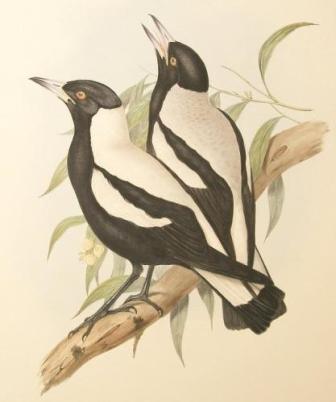
Ausralian magpie
http://www.nzbirds.com/birds/magpie.html
Today, I live in the same area of country with my own family and the magpies still gargle and warble their song on the lawn outside the bedroom window.  I've noticed that for the past 3 years the same magpie - identified by his or her unique call - has been boss of the flock that live down in the gully.   She (as I believe in a matriarchial society!) always finishes with  one call repeated twice and it sounds as though she's saying "Come on! Come on!"  But this year I've not heard her.  There's a different chorus, newcomers no doubt. 

I love to hear the birds in each different country I'm in.  The coo-coo of pigeons in England,  screech of the brilliantly coloured Aussie birds, the Mina birds up north, but always, it's the magpies that bring me home with their loud warbling, gargling... oodle, ardle, wardle, doodle